Why a Fitting Room Mirror Tells You Less Than Your Phone Camera
Quick Answer: Fitting room mirrors are frequently paired with lighting angles and mirror placement chosen to flatter, and you view yourself from one fixed distance and angle. A phone photo captures a fixed, comparable record you can look at later in different light — which is why the same outfit can seem transformed between the store and your bedroom.
The dress looked incredible in the store. It looks fine at home. Nothing about the dress changed in the drive.

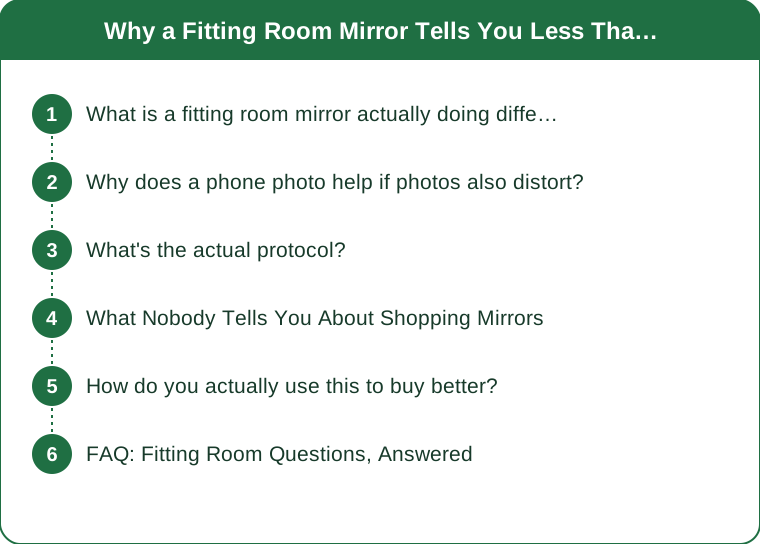
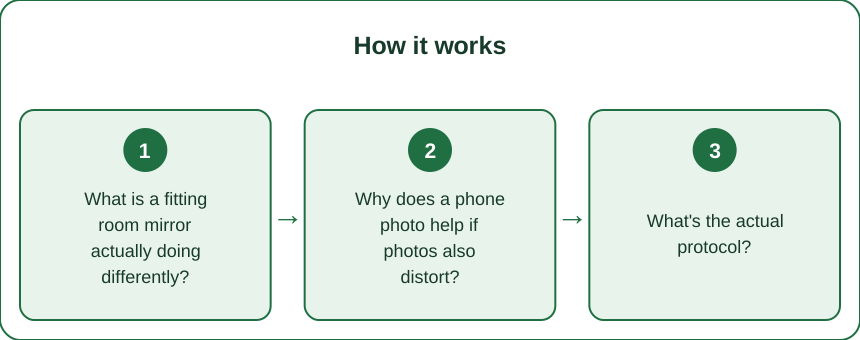
What is a fitting room mirror actually doing differently?
Several things at once, none of them sinister and all of them consequential. Lighting from above and slightly in front reduces visible shadow compared to overhead-only lighting, which is what most homes have. Warmer color temperature renders skin more evenly than cool daylight bulbs.
Mirror placement and any slight tilt change the viewing angle. And crucially, you’re looking at yourself from a fixed distance in a small room, usually straight on — which is close to the single most flattering angle available and nothing like how anyone else will see the outfit.
Why does a phone photo help if photos also distort?
Because the value isn’t accuracy — it’s consistency and delay. A photo lets you view the outfit later, in different light, from a distance, without the emotional context of the shopping trip.
The comparison is what matters, not the absolute image. Photograph three options the same way and the differences between them are reliable even if each individual photo isn’t a perfect record. And a photo removes the single largest distortion of all: the fact that you’re evaluating in a state of active want.
What’s the actual protocol?
Four shots, same setup, every time. Front, side, seated, and one arms-up. Same distance, same phone position, no posing.
Seated is the one people skip and the one that catches the most problems — waistbands, hem behavior, and fabric strain all appear when you sit and vanish when you stand. Arms-up catches armhole depth and hem rise. Keep the photos in one album and you build a personal fit archive that’s genuinely useful the next time you’re deciding between two similar cuts.

What Nobody Tells You About Shopping Mirrors
Some retailers use slightly elongating mirrors. It’s a known practice, not a conspiracy theory, and it’s undetectable from inside the room.
Your phone’s front camera has its own distortion. Wide-angle lenses exaggerate whatever is closest to the lens. Use the rear camera in a mirror instead when the shape matters.
Store lighting is usually warmer than home lighting. Color reads differently, which is why a beige that looked warm turns out cool at home.
Time of day changes your body slightly. Fluid retention varies through the day, so an afternoon fitting and a morning one aren’t strictly comparable.
The tag is a suggestion. Sizing varies enormously between brands and even between garments within a brand, which is exactly why photos beat sizes as a record of what worked.
How do you actually use this to buy better?
Photograph, leave, decide later. The delay is the mechanism — it separates the decision from the environment designed to influence it.
Specifically: take the four shots, walk out without buying, and look at the photos that evening in your own light. For online shopping, take the same four shots when the package arrives, before removing tags, and compare against your archive of things that worked. Most people find their return rate drops sharply, not because they buy less, but because they stop buying the things that were only working in one room.
FAQ: Fitting Room Questions, Answered
Is it rude to take photos in a fitting room?
Most retailers have no issue with photographing yourself in a garment. Some restrict photography of merchandise for other reasons, so a quick ask resolves it.
What about stores with no mirror in the room?
Communal mirrors under general store lighting are usually a more honest test than a private room’s, even though they’re less comfortable.
Does this apply to online shopping too?
More so. Photograph everything before removing tags and compare against past items that worked — it’s the closest thing to a fitting room the process offers.
TL;DR:
- Fitting room lighting, mirror placement, and viewing angle are all optimized environments
- A phone photo’s value is consistency and delay, not accuracy
- Shoot four fixed angles: front, side, seated, arms-up
- Seated is the shot that catches the most problems and the one most often skipped
- Decide later, in your own light, away from the room designed to sell
The garment isn’t lying to you. The room is doing some of the talking, and a photo lets you hear it again somewhere else.
Keep Reading
This article is for general informational and styling purposes only. Fit, sizing, and product availability may vary.
