Why Does the Same Size Fit Differently in a Cold Shop Than a Warm One?
Quick Answer: Temperature changes both your body and the fabric. Warmth causes mild peripheral vasodilation and slight swelling, particularly in hands, feet, and lower legs, and it also relaxes elastane, making stretch fabrics looser. Cold does the reverse. A garment tried on in a cool store on a warm body will read differently from the same garment at home, and the gap is largest in fitted stretch items and shoes.
It fit in the shop. You were sure.
You put it on four days later and it is a different garment.
Before you conclude your body changed in four days, consider that you tried it on at 18°C after walking in from 27°C, and you are now wearing it at 22°C having sat down all morning.

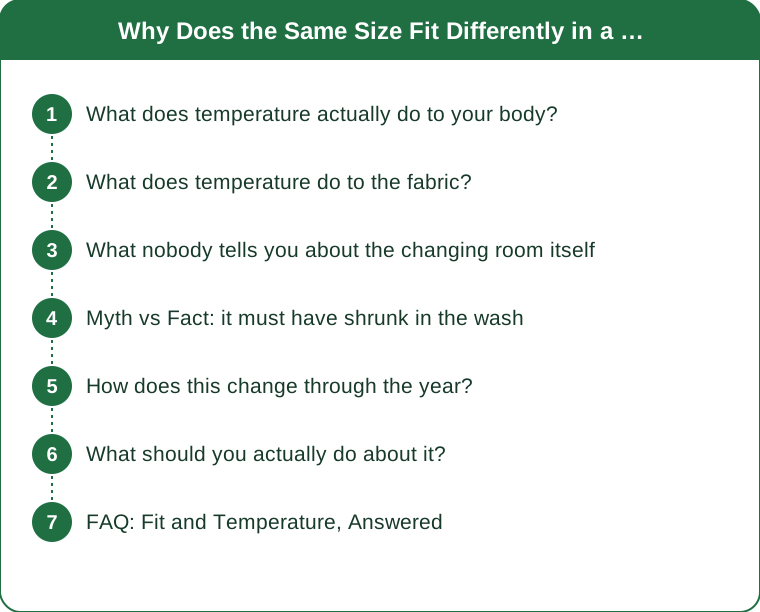
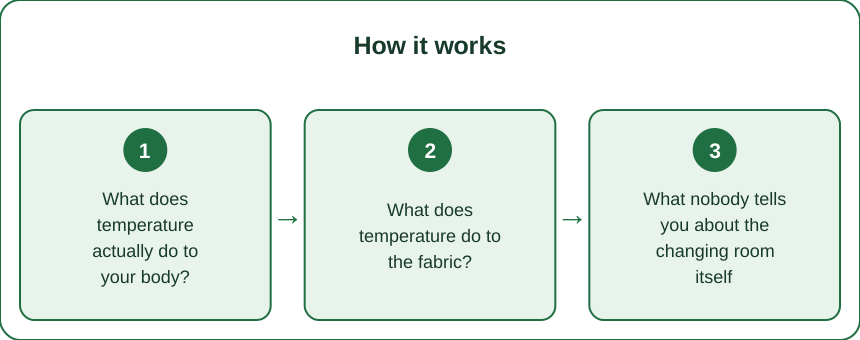
What does temperature actually do to your body?
More than most people would expect, and it happens over minutes rather than days.
When you are warm, your body dilates the blood vessels near your skin to shed heat. That brings more blood volume to the periphery — hands, feet, lower legs, and to a lesser extent the whole surface. Combined with a small amount of fluid shifting into surrounding tissue, this produces genuine, measurable swelling.
When you are cool, the opposite happens. Vessels constrict, blood moves centrally, and your extremities become measurably smaller.
The difference is not dramatic on your torso. On your feet and lower legs it absolutely is, which is why shoe fitting advice universally says to try shoes at the end of a warm day.
Add the other daily variables — you are slightly larger in the evening than the morning, and larger after salt, alcohol, a long flight, or a hot day — and the same body can genuinely present at a different size within twenty-four hours without anything changing about you at all.
What does temperature do to the fabric?
This is the half that almost nobody accounts for, and for stretch garments it is larger than the body effect.
Elastane, spandex, and Lycra are temperature-sensitive. Warm elastane is more relaxed and stretches more readily. Cold elastane is stiffer and recovers more aggressively. A pair of leggings at 15°C and the same pair at 30°C behave measurably differently.
So a garment that has been sitting on a rail in an air-conditioned store is at its firmest and most compressive. It reads as more supportive and slightly smaller. Take it home to a warm room and it relaxes.
Natural fibers respond to humidity more than temperature. Cotton and linen absorb moisture from the air and relax as they do. A linen shirt in a humid August room is looser than the same shirt in a dry heated room in January.
Wool moves both ways and is the most affected by humidity of the common fibers.
So you have two variables moving simultaneously, and in a cold store they move in opposite directions: your body is at its smallest and the fabric is at its firmest. That combination produces a fit reading that is not representative of how you will actually wear it.
What nobody tells you about the changing room itself
Changing rooms are not neutral environments, and several of the differences work against an accurate fit assessment.
They are usually warmer than the shop floor, because they are small, enclosed, and often poorly ventilated. So you spend fifteen minutes shopping while cooling down and then step into a warm cubicle and start warming up again — meaning your body is actively changing during the try-on.
You have usually just been walking. Ten minutes of walking around a store brings blood to your legs and feet, which is why trousers and shoes read differently at minute two and minute fifteen.
You are almost always standing. Most garments are worn sitting for a substantial part of the day, and waistbands behave completely differently seated. Sitting down in the changing room is the single most informative thing you can do in there, and most people never do it.
The lighting and mirror are working against you in a separate way, but that is a different problem from fit.
The most useful adjustment: wear the garment for a full five minutes and sit down for one of them. The first thirty seconds of a fitted garment tells you almost nothing about how it will feel in hour three.

Myth vs Fact: it must have shrunk in the wash
Myth: If it is tighter after the first wash, it shrank.
Fact: Sometimes, but often it did the opposite of shrink — it recovered. Stretch garments are typically shipped and displayed slightly relaxed. The first wash returns the elastane closer to its true resting dimension, which reads as shrinkage and is actually the garment arriving at its real size.
Myth: If it fit in the shop, my size is my size.
Fact: The shop fit is one data point taken in unrepresentative conditions on a body at one point in its daily cycle. It is useful, not definitive.
Myth: My weight changed.
Fact: A one to two kilogram swing over a few days is overwhelmingly likely to be fluid, not tissue, and fluid distributes to exactly the places that make clothes feel different — waistband, lower legs, hands.
Myth: The brand changed their sizing.
Fact: Sometimes true and worth checking, but it is the least likely of the explanations and the first one people reach for. Temperature, time of day, and the wash state of the garment account for far more of the variance.
How does this change through the year?
Autumn is when this gets most confusing, and there is a specific reason.
Through summer you have been shopping warm, in stores that are aggressively air-conditioned, buying mostly loose or minimally structured clothing. The gap between shop conditions and home conditions is at its largest, but the garments are forgiving enough that it rarely matters.
As the season turns, you start buying fitted and structured items — trousers, boots, jackets, knitwear — in stores that are now heated rather than cooled. Your body arrives cold from outside rather than hot, and it warms up during the visit rather than cooling down.
That flip catches people. In summer, things you buy tend to fit slightly looser at home than in store. In winter, they tend to fit slightly tighter, because you tried them on while still cold from outside.
Boots are the extreme case. Trying boots on with cold feet in October, having walked in from a chilly street, is close to a worst case. Your feet are at their smallest and will be a different size by 4pm on a warm day. Try boots on later in the day, with the socks you will actually wear, after you have been inside for at least ten minutes.
What should you actually do about it?
A short set of habits that removes most of the uncertainty.
Give it five minutes. Put the garment on and leave it on while you look at something else. Both your body and the fabric will move toward equilibrium.
Sit down in it. Once, properly. Waistbands, knees, and shoulders all reveal themselves seated.
Note the store temperature. If you walked in from a very different temperature, mentally discount the reading in that direction. Cold store on a cold day means it will likely feel snugger at home.
Shop at a consistent time of day if you are between sizes. Afternoon is the most representative for most people.
Wear the underlayers you will actually wear. This affects the fit verdict more than most single variables, and it is free to control.
Keep the receipt and try it again at home in the conditions you will actually wear it. This is the only genuinely reliable test, and it is why generous return policies exist.
None of this means the shop fitting was wrong. It means it was one reading in one set of conditions, and knowing which direction those conditions push you is enough to interpret it properly.
FAQ: Fit and Temperature, Answered
How much difference are we actually talking about?
Small in absolute terms — typically a fraction of a size. But fit perception is not linear, and the difference between comfortable and slightly tight is often a very small measurement. Small changes land right at that threshold.
Does this apply to non-stretch clothing?
Less, but not zero. The body side still applies fully. The fabric side is mostly about humidity rather than temperature for natural fibers, and structured garments are less forgiving of body changes precisely because they cannot stretch to accommodate them.
Should I size up for summer?
Not as a rule. If you are between sizes and the garment is for warm-weather wear, the larger size is the safer choice. For year-round items, fit them in the conditions where you have least tolerance — usually the warmest.
Why do leggings feel tight for the first few minutes and then fine?
Body heat warming the elastane, plus the fabric settling into your shape. This is normal and it is why the thirty-second verdict in a changing room is unreliable. Give it five minutes before deciding.
TL;DR:
- Warmth causes mild peripheral swelling and relaxes elastane; cold does the reverse — so a cold store gives you your smallest body and the fabric’s firmest state at the same time.
- That combination makes garments read smaller and more supportive than they will be at home.
- Changing rooms are warmer than shop floors, and you have usually just been walking, so your body is actively changing during the try-on.
- Autumn flips the usual direction: heated stores and a body arriving cold from outside means things often feel tighter at home rather than looser.
- Five minutes wearing it, one minute sitting down, and the underlayers you will actually wear removes most of the guesswork.
None of this makes sizing a lottery. It makes the shop fitting one reading rather than a verdict — and knowing which way the conditions were pushing you is usually enough to know whether to trust it.
See It in Motion
Seen here: High Waist Yoga Leggings with Side Pockets — shop it on bubblelime.com
Keep Reading
This article is for general informational and styling purposes only. Fit, sizing, and product availability may vary.
