Why the Same Outfit Fits Differently After a Bad Night's Sleep
Quick Answer: Poor sleep raises cortisol, disrupts the hormones that regulate sodium and fluid balance, and increases low-grade inflammation — all of which push the body toward holding water. That shows up as 0.5 to 1.5kg of overnight fluid change, mostly in the face, fingers, ankles and abdomen. Nothing about your body composition changed. The waistband is genuinely tighter and it means nothing at all about your progress.
This is one of the most common reasons a perfectly good outfit gets rejected at 7am.
And one of the least useful reasons to change your plans for the day.

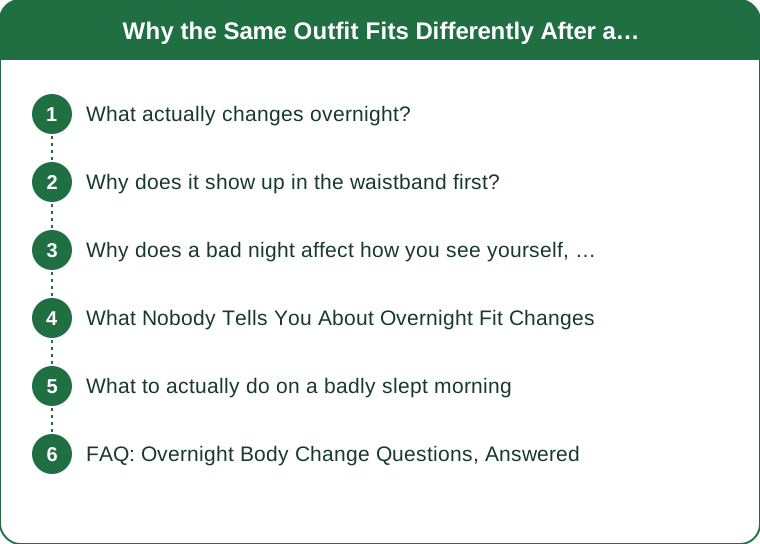
What actually changes overnight?
Fluid distribution, almost entirely.
Sleep is when a great deal of regulatory work happens. Poor or short sleep disrupts several systems at once:
Cortisol rises. Elevated cortisol promotes sodium retention, and where sodium goes, water follows.
Antidiuretic hormone patterns shift, changing how much fluid your kidneys hold onto overnight.
Inflammatory markers increase modestly with sleep deprivation, and inflammation itself is associated with fluid retention in tissues.
Lymphatic drainage is less effective when you sleep badly, particularly if you slept in an awkward position or barely moved.
The visible result is puffiness in the face and hands first, then ankles, then a general sense that everything is fractionally larger. On a scale, that is often 0.5 to 1.5kg more than the previous morning.
None of it is fat. You cannot gain a kilogram of fat overnight — that would require an extra 7,000 or so calories, which nobody eats by accident. What you can do, easily, is hold an extra litre of water.
Why does it show up in the waistband first?
Because that is where clothing has the least tolerance for change.
A waistband is a fixed circumference at the point where your body varies most through the day. Abdominal circumference genuinely changes with digestion, fluid, and even how much air is in your gut — variations of 2 to 4cm across a normal day are completely ordinary.
Add overnight fluid retention on top of a day’s normal variation and you are asking a fixed waistband to accommodate a range it was never sized for. Meanwhile a top with any drape absorbs the same change invisibly, which is why people say their trousers do not fit but their shirt is fine.
The other clue that this is fluid rather than anything else: it is symmetric and it affects your rings and shoes too. If the waistband is tight and your rings are also snug and your trainers feel narrow, that is fluid. A pattern affecting only one garment is more likely to be about that garment.
Why does a bad night affect how you see yourself, separately from the fit?
Because sleep deprivation changes perception, not just the body.
This is worth separating out honestly. Poor sleep is associated with more negative self-appraisal across the board — research on sleep and mood is consistent on this — and body image is not exempt. On a badly slept morning you are both slightly puffier and more inclined to interpret what you see unfavourably.
The two effects compound. A 1cm change in waist circumference is not visible to anyone else and barely registers in a photograph, but combined with a brain that is primed to find fault, it becomes the thing you notice in the mirror for ten minutes.
The practical implication is not to talk yourself out of what you are seeing — the fluid is real. It is to be sceptical of the conclusion you draw from it. A tight waistband on four hours of sleep is information about last night, not about the last month.
And it resolves. Typically within 24 to 48 hours of a normal night, without doing anything in particular.

What Nobody Tells You About Overnight Fit Changes
The bad-sleep effect stacks with everything else. Late meal, salty dinner, alcohol, long flight, hot weather, a hard training session the day before, and the point in your menstrual cycle all push fluid in the same direction. A bad night alone is a small effect. A bad night after a salty dinner and a hard session is a noticeably different body in the morning.
Training makes it worse before it makes it better. A hard or unfamiliar session causes muscle damage and a local inflammatory response, which brings fluid into the tissue. That is a normal part of adaptation, and it means the morning after a heavy leg session your leggings are genuinely tighter. This is one of the reasons people starting a new programme feel like it is not working in week two.
And the part almost nobody says out loud: the clothes in your wardrobe were bought on your best days. You tried them on in a shop, in the afternoon, feeling reasonably good, and you bought the ones that fit then. Half your wardrobe is calibrated to a version of you that exists some days and not others. That is not a body problem; it is a sampling problem.
What to actually do on a badly slept morning
Practical, in order.
Wear the forgiving thing. Every wardrobe has two or three items that work across a wider range. On a puffy morning, that is what they are for. This is not defeat, it is having the right tool.
Do not weigh yourself, or if you do, do not act on the number. A single morning’s weight after poor sleep is noise. Weekly averages are the only thing worth reading.
Move early. A ten-minute walk does more for fluid distribution than anything else available to you, because muscle contraction drives lymphatic return.
Drink water. Counterintuitively, mild dehydration promotes retention. Drinking normally helps rather than hurts.
Go easy on sodium that day if it is bothering you, but do not overcorrect — very low sodium has its own problems.
Do not make decisions. Not about your diet, not about your training programme, and not about what your body looks like. A badly slept morning is the worst possible time to evaluate anything.
This is general information, not medical advice. Swelling that is one-sided, painful, sudden, or persistent — particularly in a single leg — needs medical attention rather than a walk.
FAQ: Overnight Body Change Questions, Answered
How long does it take to go back to normal?
Usually 24 to 48 hours after a normal night’s sleep, sometimes faster with movement and normal hydration. If it persists for more than a few days without an obvious cause, it is worth mentioning to a doctor.
Is it worse as you get older?
Somewhat, for most people. Fluid regulation becomes slightly less efficient and sleep quality tends to decline, so the effect is more noticeable and takes marginally longer to resolve.
Why is it worse after a flight or a long drive?
Prolonged sitting reduces the muscle pumping that drives lymphatic and venous return, and cabin pressure and dry air add to it. A long journey plus a short night is the reliable combination for a genuinely puffy morning.
Should I buy clothes in a bigger size to allow for this?
Not generally — buy for your usual state and keep two or three genuinely comfortable items for the days that need them. Sizing your whole wardrobe for your worst mornings means most days you are wearing clothes that do not fit either.
TL;DR:
- Poor sleep raises cortisol and shifts fluid regulation, adding 0.5 to 1.5kg of water
- Waistbands show it first because they have the least tolerance for normal daily variation
- Sleep deprivation also makes you judge what you see more harshly, so the two effects compound
- It resolves in 24 to 48 hours with a normal night, movement, and normal hydration
- Do not weigh, evaluate, or make decisions on a badly slept morning
The outfit did not stop fitting and your body did not change. You are holding a bit of water on four hours of sleep, which is exactly what a body is supposed to do — and by Thursday you will have forgotten you thought about it at all.
Keep Reading
This article is for general informational and styling purposes only. Fit, sizing, and product availability may vary.
