Why Your Measurements Change Through the Day - and Why That Is Not a Problem
Quick Answer: Waist circumference commonly varies by an inch or more across a day, driven by digestion, hydration, sodium, hormonal cycle and posture. Body weight varies by two to five pounds for the same reasons. None of that reflects change in body composition, which moves far too slowly to show up daily. Measure at the same time under the same conditions, and judge by four-week trends rather than by any single reading.
You measure in the morning and again at 8pm and the tape says something different.
Neither reading is wrong. You were asking a question the tape cannot answer that precisely.

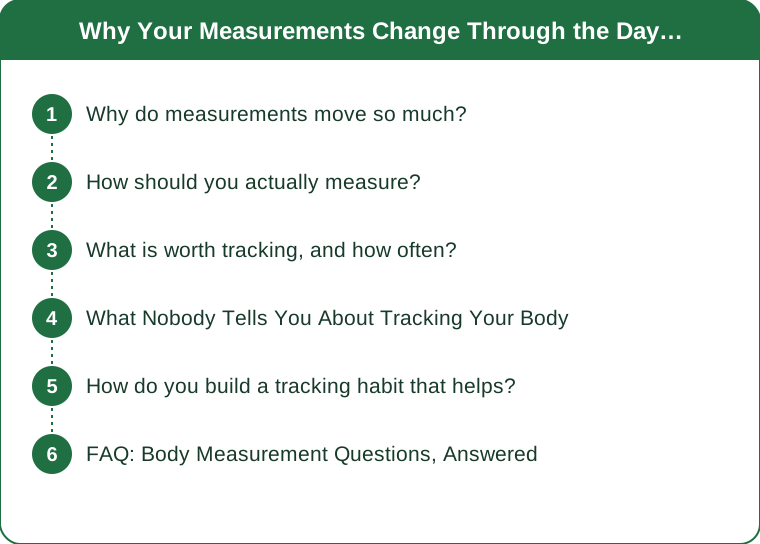
Why do measurements move so much?
Digestion is the largest daily factor. Food and liquid in the digestive tract have real volume, and the gut holds a meaningful amount at any given time.
Hydration status shifts body weight by pounds. A litre of water weighs about 2.2 pounds, and daily fluid balance varies by more than that.
Sodium intake drives water retention, and a high-sodium meal can add noticeable water weight for a day or two with no change in body composition.
Hormonal cycles produce predictable fluid shifts for menstruating people, commonly two to five pounds and a visible change in abdominal measurement.
Carbohydrate intake affects stored glycogen, and each gram of glycogen is stored with roughly three grams of water. A high-carbohydrate day is heavier the next morning by design.
Posture and breathing change a waist measurement instantly - standing tall versus relaxed, exhaled versus mid-breath, can differ by an inch on the same person in the same minute.
And measurement technique varies more than people think, with tape tension and placement height both contributing.
How should you actually measure?
Same time of day, every time - first thing in the morning is the most stable.
After using the bathroom and before eating or drinking.
Same clothing, or none.
Waist at the narrowest point or at the navel - pick one and always use it. Both are valid; inconsistency between them is not.
Tape snug but not compressing the skin, and level all the way around. A mirror helps, and so does a spring-loaded tape that standardises tension.
Relaxed, at the end of a normal exhale. Not sucking in, not pushing out.
Measure two or three times and take the middle value, which removes most technique noise.
And measure the same day of the week, which controls somewhat for weekly patterns in eating and training.
What is worth tracking, and how often?
Weekly is the most useful frequency for most measurements, and monthly is fine.
Daily weighing is only useful as a seven-day average, because the daily number is dominated by noise. The average is genuinely informative; any single day is not.
Track a small set: weight, waist, hips, and one other point that matters to you.
Photographs under consistent conditions - same light, same position, same time - often show change that numbers miss entirely.
How clothes fit is a legitimate and underrated metric, and it integrates changes that a single circumference misses.
Performance measures are the best trackers of all for most goals - weight lifted, distance run, how a set feels - because they respond faster and reflect what you are actually training.
And judge everything on a four-week window. Meaningful body composition change over less than that is smaller than the measurement error.

What Nobody Tells You About Tracking Your Body
Daily weight variation of two to five pounds is completely normal and reflects water, food volume and glycogen. People routinely interpret a two-pound overnight rise as fat gain, which would require an implausible calorie surplus.
Water retention from a hard workout can mask fat loss for two weeks. Muscle damage from unfamiliar training draws in fluid, so a new program can produce a stalled or rising scale while composition is improving. This catches people at exactly the moment they need encouragement most.
Menstrual cycle fluid shifts are large enough to hide a month of progress, which is why comparing the same point in consecutive cycles is far more informative than comparing week to week.
Measurement error is often larger than a month of real change. A tape measure in a different position by half an inch produces a bigger difference than four weeks of genuine progress.
Bioimpedance scales are heavily affected by hydration and are best used for trends rather than absolute body fat numbers. The number on the display carries a wide error margin.
Progress rarely arrives evenly. Whooshes - several days of nothing followed by a sudden drop - are common and usually reflect fluid rather than a sudden change in fat.
And more frequent measurement makes people less accurate at judging their own progress, because the noise dominates and the trend gets lost in it.
How do you build a tracking habit that helps?
Pick one morning a week and measure then, always.
Log the number without reacting to it. The individual value is data; the trend is information.
Review monthly, not weekly, and look at the line rather than the last point.
Add one performance metric and give it equal weight - it responds faster and it is more directly under your control.
Take photographs monthly in consistent conditions.
Note context alongside the number - a hard training week, a high-sodium weekend, cycle timing - since that context explains most of the outliers.
And stop tracking entirely if it is making things worse. For some people, frequent measurement drives anxiety without adding useful information, and performance and clothing fit are perfectly adequate substitutes. If tracking is affecting your relationship with food or your body, that is worth discussing with a professional. This is general information, not medical advice.
FAQ: Body Measurement Questions, Answered
How much can my weight change in a day?
Two to five pounds is normal, driven by food volume, hydration, sodium and glycogen. None of it reflects change in body fat.
When is the best time to measure?
First thing in the morning, after using the bathroom, before eating or drinking. Consistency matters more than the specific time.
How often should I measure?
Weekly for circumferences, and if you weigh daily, use the seven-day average rather than any single day. Review the trend monthly.
Why did my waist go up after starting a new program?
Unfamiliar training causes fluid retention in the working muscles, which can mask progress for a week or two. It resolves as you adapt.
Are body fat scales accurate?
They are heavily affected by hydration and carry a wide error margin on absolute values. Use them for trends under consistent conditions, not for the number itself.
What is a better measure than the tape?
Performance metrics and how clothes fit. Both respond faster, are less noisy, and reflect what you actually care about more directly.
TL;DR:
- Waist can vary by an inch and weight by two to five pounds within a single day - all of it water, food volume and glycogen.
- Measure at the same time, same conditions, same landmark, relaxed at the end of an exhale.
- Daily weight is only useful as a seven-day average; the individual day is noise.
- Judge on a four-week window - real composition change over less time is smaller than measurement error.
- New training programs cause fluid retention that can mask progress for two weeks.
- Performance metrics and clothing fit are faster, less noisy, and often more useful than the tape.
If tracking is making things worse, stopping is a legitimate choice. This is general information, not medical advice.
Keep Reading
This article is for general informational and styling purposes only. Fit, sizing, and product availability may vary.
