Why Clothes Fit Differently After the First Wash — and Which Fibers Do It
Quick Answer: Cotton and rayon shrink on the first wash, usually 3 to 5 percent, mostly in length. Elastane relaxes and loses recovery with heat. Wool felts if agitated. The first wash is where a garment settles into its actual dimensions — which means the fit you buy is not the fit you keep, and it is predictable from the fiber content label.
The leggings fit perfectly in the store and fit differently after Tuesday.
Nothing about you changed in four days, and the garment is now a slightly different garment.
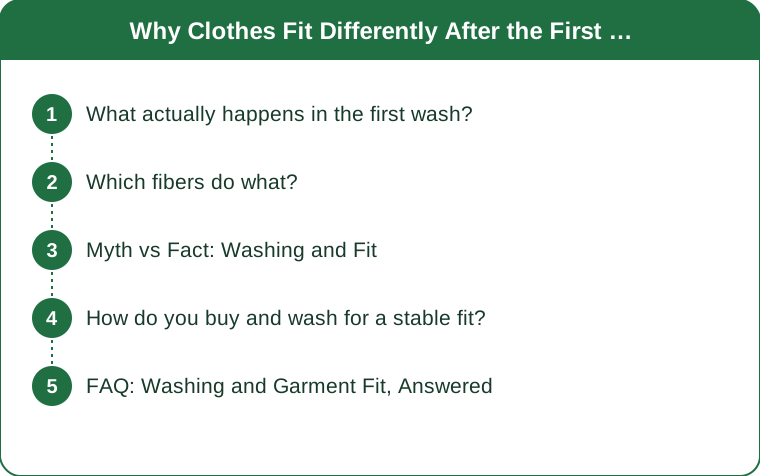
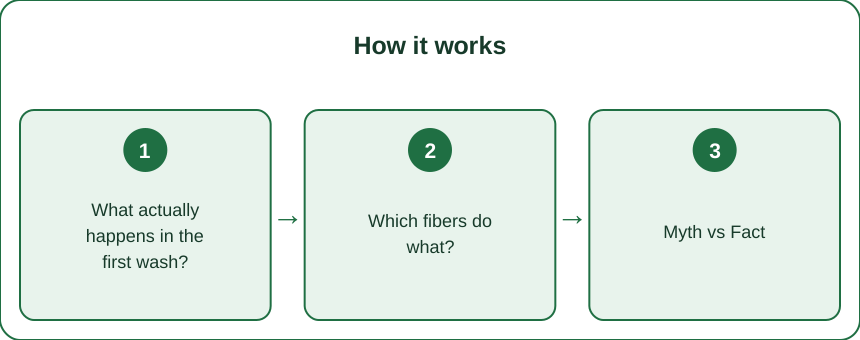
What actually happens in the first wash?
Fibers release the tension that manufacturing put into them.
Knitting and weaving stretch the yarn under tension. That tension is held in place through finishing and packaging. Water and heat let the fibers relax back toward their natural length, and the fabric contracts — this is relaxation shrinkage and it happens on the first wash.
Cotton absorbs water and swells across its width. Swollen fibers take up more space sideways, which pulls the yarn shorter lengthwise. This is why cotton shrinks in length more than in width, and why a t-shirt gets shorter before it gets narrower.
Heat is the multiplier for all of it. Warm water accelerates relaxation and a hot dryer does more shrinking than the wash itself. Most reported shrinkage is actually dryer damage.
Elastane degrades rather than shrinks. It does not contract; it loses recovery. Heat, chlorine, and body oils break down the polymer over time, so the garment stops springing back and starts sagging at knees and seat.
Sizing accounts for expected shrinkage — sometimes. Preshrunk cotton has been washed and dried at the mill, so most of the relaxation is already spent. Labels that do not say preshrunk generally have not been.
Which fibers do what?
The content label predicts almost all of it.
Cotton: shrinks 3 to 5 percent on first wash, more if not preshrunk. Mostly in length. A t-shirt loses an inch or so of body length and very little width.
Rayon and viscose: shrinks the most, 5 to 10 percent, and can be unpredictable. It weakens substantially when wet, so agitation while wet causes distortion as well as shrinkage. Hand wash or cold gentle, always.
Polyester and nylon: essentially stable. They do not absorb water meaningfully and are heat-set during manufacturing. A polyester garment will fit the same on wash twenty as on wash one — the reason technical activewear holds its shape.
Elastane blends: no shrinkage, gradual loss of recovery. Five to 10 percent elastane in leggings is what makes them hold. Hot washing and tumble drying cut its useful life dramatically, which shows up as bagging rather than as a size change.
Merino and wool: shrinks by felting, and it is permanent. Agitation plus heat makes the scales on wool fibers interlock. Unlike relaxation shrinkage, felting cannot be reversed by stretching it back out.
Linen: shrinks 3 to 4 percent and softens considerably. The fit change is modest and the hand-feel change is large, generally in the direction you want.
Myth vs Fact: Washing and Fit
Myth: Cold water prevents all shrinkage. Fact: Cold reduces it substantially and does not eliminate relaxation shrinkage, which is driven by water more than by heat. Cold washing plus air drying gets you most of the way; nothing gets you all the way with untreated cotton.
Myth: Shrunken clothes can be stretched back. Fact: Relaxation shrinkage in cotton can be partially recovered by stretching while damp. Felted wool cannot be recovered at all, and degraded elastane cannot be restored by anything.
Myth: Expensive clothes shrink less. Fact: Fiber content and finishing decide this, not price. An expensive unpreshrunk cotton shirt shrinks more than a cheap polyester one. What price often buys is consistency and better finishing, which is a different thing.
Myth: Activewear does not change with washing. Fact: The polyester and nylon do not, and the elastane absolutely does. Leggings that have lost their compression have not shrunk or stretched out — the recovery fiber has degraded, usually from dryer heat.
Myth: You should buy a size up to allow for shrinkage. Fact: Only for unpreshrunk cotton and rayon, and only in length. Sizing up in a synthetic blend gives you a garment that will never fit, because it was never going to shrink — and this is the mistake that quietly fills half a wardrobe.
How do you buy and wash for a stable fit?
Read the content label before the size label.
Check fiber content first, in the store. It tells you more about how the garment will fit in a month than trying it on does. This takes five seconds and changes what you buy.
Wash cold and air dry anything with elastane. This is the single highest-value laundry habit for activewear. Dryer heat is what kills recovery, and avoiding it can double the useful life of a pair of leggings.
Turn technical fabrics inside out. Reduces abrasion on the outer face, which is where pilling and fading happen.
Wash the first time before you decide about a return. For cotton and rayon, the fit you have in the fitting room is not the fit you will live with. For synthetics, it is — so return decisions on synthetics can be made immediately.
Skip fabric softener on anything technical. It coats fibers, which reduces moisture wicking and can make elastane feel slack. Vinegar in the rinse does the softening job without the coating.
Expect a second small change around wash five. Progressive shrinkage continues at a much lower rate for several washes in cotton. If a shirt feels shorter than you remember two months in, that is real and it is finished by then.
FAQ: Washing and Garment Fit, Answered
How much do clothes actually shrink in the first wash?
Cotton typically 3 to 5 percent, rayon 5 to 10 percent, linen 3 to 4 percent, and polyester or nylon essentially zero. The shrinkage is mostly in length rather than width, which is why sleeves and hems change more noticeably than the body.
Why did my leggings get baggy instead of shrinking?
The elastane lost its recovery, most likely from dryer heat or hot water. The polyester or nylon holding the structure did not change size, so the garment keeps its dimensions and stops springing back. Cold wash and air dry from the start is the only real prevention.
Should I size up in cotton to allow for shrinkage?
For unpreshrunk cotton, sizing up in length is reasonable — but many cotton garments are already preshrunk, in which case sizing up leaves you with something permanently large. Check for a preshrunk or prewashed note on the label before assuming.
TL;DR:
- Cotton and rayon shrink on the first wash, mostly in length; polyester and nylon are essentially stable.
- Elastane does not shrink — it loses recovery from heat, which shows up as bagging rather than a size change.
- Wool shrinks by felting and that one is permanent; cotton relaxation shrinkage is partially recoverable while damp.
- Read the fiber content before the size label, and wash cold and air dry anything with stretch in it.
The fit you buy is the fit before the fabric has settled. Reading the content label tells you which of those two fits you will actually be living with.
See It in Motion
Seen here: High Waist Yoga Leggings with Side Pockets — shop it on bubblelime.com
Keep Reading
This article is for general informational and styling purposes only. Fit, sizing, and product availability may vary.
