Why Clothes Fit Differently the Week You Change Your Training
Quick Answer: New or intensified training causes muscle to retain water for repair, glycogen stores to increase (each gram binding roughly 3 grams of water), and connective tissue to hold inflammatory fluid. That can be several pounds of water within days, concentrated in whatever you just trained — and it resolves over one to three weeks as you adapt.
You started a new program on Monday full of good intentions. It is Thursday, your jeans are tighter than they were, and the obvious conclusion is the wrong one. This is one of the most demoralizing and most misread things in all of fitness.

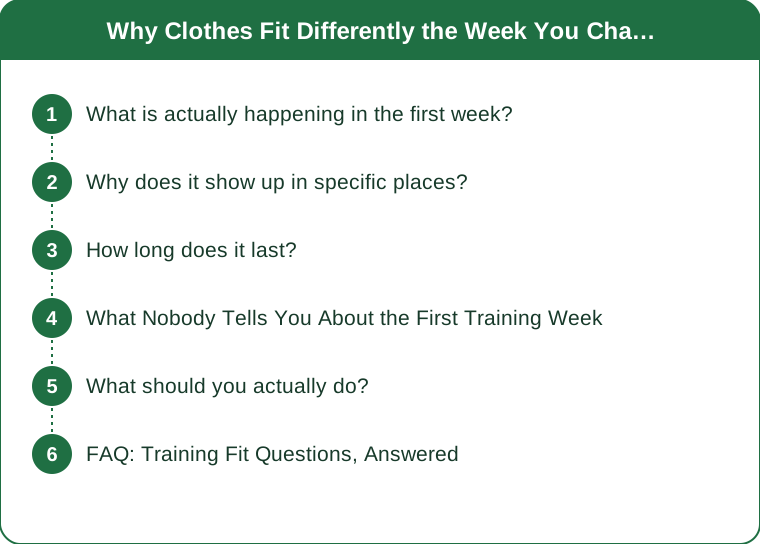
What is actually happening in the first week?
Three separate water-related processes, all pointing the same direction.
1. Muscle damage and repair. Unfamiliar training causes microscopic damage to muscle fibers. The inflammatory repair response draws fluid into the tissue. This is the same swelling mechanism as any minor injury, and it is a normal, necessary part of adaptation. It peaks around 24 to 72 hours after the session — which is why Thursday feels worse than Tuesday.
2. Glycogen loading. As you train more, your muscles increase their stored carbohydrate. Each gram of glycogen is stored with roughly 3 grams of water. A meaningful increase in muscle glycogen across the body can therefore add a few pounds of water weight with no change in body composition at all.
3. Connective tissue response. Tendons, fascia, and the tissue around muscle also respond to new load with fluid shifts.
On top of that, if you also increased your carbohydrate or sodium intake to fuel the new program — which most people do — you get additional water retention on top.
The scale reflects all of this. It is entirely normal to be up two to four pounds within the first week of new training, and essentially none of that is fat gain.
Why does it show up in specific places?
Because the retention is concentrated where the work happened, which is what makes it so specific and so confusing.
If you started a lower-body program, your thighs and glutes hold the fluid, and leggings and jeans feel tighter through exactly that area. If you started upper-body work, sleeves and shoulders feel snug. If you started running, calves.
This is why the experience is so often described as “my legs got bigger in four days,” which is not physiologically possible for actual muscle tissue. Meaningful muscle hypertrophy takes weeks to months. Fluid shifts take hours.
A few other patterns worth recognizing:
- The waistband often feels tightest even after lower-body work, because that is where clothing is least forgiving and where any general fluid retention shows first
- Rings and shoes can feel tight after a hard first week, which is general systemic retention rather than local
- Morning versus evening differences get exaggerated during this period. You are always slightly larger in the evening; a training-response week amplifies it
- The affected area is usually also sore, which is the tell. Soreness and tightness in the same place at the same time is the signature of this process, not of body composition change
How long does it last?
A predictable arc, which is the genuinely reassuring part.
- Days 1 to 3: retention builds. Soreness peaks. This is the worst point
- Days 4 to 7: soreness fades, some fluid resolves, but glycogen remains elevated
- Weeks 2 to 3: the repeated bout effect kicks in — your muscles adapt to the new stimulus and the damage response to each session drops sharply. Retention largely resolves
- Weeks 3 to 6: you settle at a new baseline. Often slightly heavier than before with a smaller measurement, which is the composition change actually beginning
The repeated bout effect is the key mechanism. After you have done a movement a few times, the same session produces dramatically less muscle damage and therefore much less swelling. This is why week one of any program is uniquely uncomfortable and week four of the same program is not.
Which means the timing of judgment matters enormously. Assessing a program in week one is measuring the disruption, not the result. Give it three weeks before drawing any conclusion, and if you take measurements, take them before you start and then not again until week four.

What Nobody Tells You About the First Training Week
The scale can go up while you are in a deficit. These processes are independent of energy balance. You can be eating less than you burn and still be three pounds heavier on Friday. This combination — doing everything right and seeing the number rise — is the single most common reason people quit in week one.
It is worse if you took time off. Coming back after a break produces a larger damage response than continuing, because the repeated bout effect has partly worn off. The return week is often harder than the original start.
Cycle phase stacks on top. Fluid retention in the luteal phase can add its own pounds, and if a new program starts in that window the two effects combine into something that looks alarming and is nothing.
Clothes are a better measure than the scale, but not this week. Ordinarily fit is the more honest signal. During a training-response week it is the most distorted signal you have, because the retention is concentrated exactly where your clothes are tightest.
More water helps, not less. The instinct to restrict fluid is exactly backwards. Adequate hydration and sodium support normal fluid regulation; restricting them tends to make retention worse, not better.
What should you actually do?
Mostly wait, with a few things that genuinely help.
Helpful:
- Keep training. The fastest route through this is the repeated bout effect, and the only way to get it is to repeat the bout. Session three of a movement produces far less swelling than session one
- Ease into new programs. Starting at 60 to 70 percent of your intended volume for the first week reduces the damage response substantially without slowing your progress
- Sleep and hydrate normally. Both support the inflammatory resolution process
- Move on off days. A walk assists fluid clearance more than lying still
Not helpful:
- Cutting calories further in response to the scale. The problem is not energy balance
- Restricting water or salt
- Weighing daily and reacting to it. If you weigh, use a weekly average and ignore individual days
- Abandoning the program. Week one is the least representative week there is
And the wardrobe advice, which is not trivial: keep wearing what fits. Buying a size up in week two of a program is a decision made on data that will not exist in a month. If something is uncomfortable, wear something else you already own for two weeks. This resolves. It always resolves, and the schedule it resolves on is the same for almost everyone.
FAQ: Training Fit Questions, Answered
How much weight is normal to gain in the first week?
Two to four pounds is common and unremarkable. More than that is usually a bigger training jump, a significant carbohydrate increase, or cycle timing on top. Actual fat gain of four pounds in a week would require an enormous and sustained calorie surplus.
Does this mean I should not weigh myself when starting something new?
A reasonable position, or at least weigh knowing that the first two weeks are noise. Weekly averages, monthly photos, and how lifts and runs are progressing are all more informative during this period than daily weight.
Will my legs stay bigger if I keep lifting?
Muscle growth is real but slow — a few pounds over many months with consistent training, not days. What changes fast is fluid. Most people who continue find that the week-one tightness resolves and their clothes end up fitting the same or better within a month, with a body that does more.
TL;DR:
- New training causes muscle repair fluid, glycogen water, and connective tissue swelling — several pounds in days
- It concentrates where you trained, which is why one specific garment suddenly feels tight
- The repeated bout effect resolves it over one to three weeks, and it happens to everyone
- Keep training, ease into volume, hydrate normally, and do not judge a program or buy clothes in week one
The cruelest part of starting something is that the first week gives you the worst possible feedback. Knowing the schedule in advance is most of what gets people to week four, which is where the real information starts.
Keep Reading
This article is for general informational and styling purposes only. Fit, sizing, and product availability may vary.
