Why the Mirror and the Changing Room Disagree So Completely
Quick Answer: Mirrors disagree because almost none of them are neutral. Overhead lighting casts downward shadows that emphasise texture, mirror tilt of even a few degrees stretches or compresses your reflection, and glass quality varies enough to distort shape. Add the fact that your own perception shifts with mood and time of day, and the disagreement is entirely expected. The most accurate reflection is a flat, vertically mounted mirror in soft front-facing daylight — which describes very few changing rooms.
You tried it on at home and it was lovely.
Under shop lighting an hour earlier, the same garment looked like a mistake.
One of those mirrors was lying, and quite possibly both.
What makes mirrors disagree so much?
Four variables, and shops get most of them wrong.
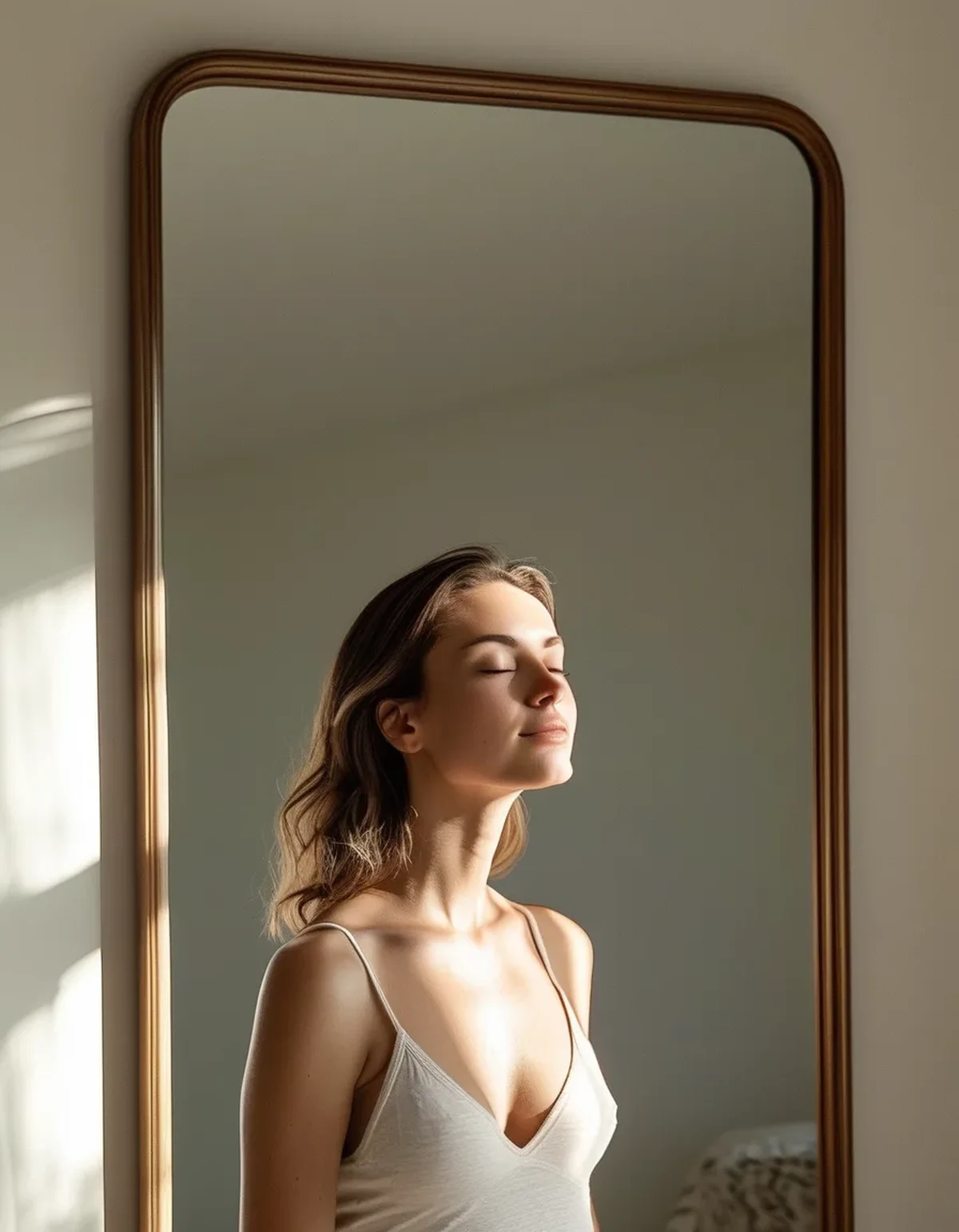
Lighting direction dominates everything. Overhead lighting casts shadows downward, emphasising every contour and texture. Front-facing or diffuse light flatters because it fills those shadows.
Mirror tilt changes proportions. Many shop mirrors lean back slightly, which is often deliberate — it elongates the reflection. A mirror tilted the other way compresses it. A few degrees is visibly significant.
Glass quality varies more than you would expect. Cheap mirrors have slight surface irregularities that produce genuine distortion, particularly toward the edges.
Distance and viewing angle matter. A mirror one metre away shows a different perspective than one three metres away, and closer viewing exaggerates whatever is nearest to the glass.
Colour temperature shifts skin tone. Cool white light drains warmth from skin; warm light adds it. Neither is neutral, and both change how a garment’s colour reads against you.
And your own state is a variable. Perception genuinely shifts with mood, fatigue, time of day and what you were doing beforehand. The reflection is only half the equation.
How do you get an honest look?
Control the two things that matter most: light and geometry.
Use natural daylight, indirect. Near a window but not in direct sun. This is the closest thing to a neutral reference available.
Check the mirror is flat against the wall. If it leans, prop it vertical. It is the single largest distortion in most homes.
Stand at least two metres back. Close viewing exaggerates perspective. Distance normalises it.
Take a photo from chest height, a few paces away. Cameras have their own distortions, but they are consistent — which makes photographs better for comparison over time than any mirror.
Look once, decide, and move on. Repeated checking reliably worsens judgement rather than improving it, and the tenth look is never more accurate than the first.
Use the same mirror for comparisons. Any judgement about change over time is only meaningful in a fixed setup — same mirror, same light, same time of day.

Why does the same outfit look different at different times of day?
Because both you and the light genuinely change.
Light shifts through the day. Morning light is cool and directional; afternoon light is warm and low. The same room at 9am and 5pm is two different studios.
Your body genuinely changes. Fluid distribution shifts through the day, and most people are measurably different in the evening than the morning. Waistbands are the usual place this becomes obvious.
You are marginally shorter by evening. Spinal discs compress under load through the day, which slightly changes how hems sit.
Fatigue changes posture. Late-day posture is different from morning posture, and posture affects how clothes hang more than most people credit.
Perception shifts with mood and energy. This is well-documented and worth naming: the same reflection is genuinely evaluated differently depending on how the day has gone.
Seasonal note: as daylight hours shorten through autumn, more dressing and mirror-checking happens under artificial light. If clothes suddenly seem to look worse from September, it is very often the lighting rather than anything else.
Myth vs Fact: Mirrors and How You Look
Myth: shop mirrors are all rigged to flatter. Fact: some tilt to elongate; plenty of others have harsh overhead lighting that does the opposite. There is no consistent bias, which is exactly why they disagree with each other.
Myth: photos show the truth. Fact: lens focal length distorts noticeably, especially close up. Phone selfies at arm’s length exaggerate whatever is nearest the lens.
Myth: you see yourself as others see you. Fact: mirrors show you laterally reversed, which is why photographs often look subtly wrong to you and perfectly normal to everyone else.
Myth: a full-length mirror is a full-length mirror. Fact: mounting height and tilt change the reflection substantially. Mounted too high, it shortens you; leaned back, it lengthens you.
Myth: if it looks bad in one mirror it looks bad in general. Fact: any single mirror is one lighting and geometry condition. The garment that fails under overhead shop lighting frequently looks excellent in daylight.
Myth: how you look is fixed through the day. Fact: fluid shifts, posture and spinal compression all change measurably. Comparing morning to evening is comparing two different states.
FAQ: Mirror and Perception Questions, Answered
Which mirror at home is most accurate?
A flat, vertically mounted, full-length mirror near a window with indirect daylight. Check the tilt with a spirit level if unsure.
Why do I look better in some shops than others?
Lighting direction and mirror tilt. Neither reflects anything about the garment, which is why buying decisions made under shop lighting are so often regretted.
Should I trust photos more than mirrors?
For tracking change over time, yes — provided the setup is identical each time. For absolute judgement, neither is neutral.
Why do I look different in a video call?
Webcams use wide-angle lenses at close range, which is the most distorting configuration commonly encountered. It is the lens, not you.
Is it normal to look different morning to evening?
Completely. Fluid distribution, posture and spinal compression all change through the day.
How do I stop repeated mirror-checking?
Decide once, then leave. Repeated checking narrows attention onto details and reliably worsens judgement rather than clarifying it.
TL;DR:
- Mirrors disagree because of lighting direction, mirror tilt, glass quality and viewing distance — very few are neutral.
- Overhead light emphasises texture; soft front-facing daylight is the closest to honest.
- Check your mirror is flat against the wall and stand two metres back.
- For tracking change, use photos in a fixed setup, not different mirrors.
- You genuinely look different morning to evening — fluid, posture and spinal compression all shift.
Prop your mirror properly vertical and look at it in daylight once. It is a two-minute change and it settles a lot of arguments with yourself.
Keep Reading
This article is for general informational and styling purposes only. Fit, sizing, and product availability may vary.
