Why the Mirror and the Photo Never Quite Agree
Quick Answer: A mirror shows you a laterally flipped, life-sized, binocular view you have seen thousands of times. A photo shows you an unflipped, lens-compressed, single-perspective view frozen at one thousandth of a second. The differences are optical and psychological, not evidence about your body. Both are real; neither is the truth.
You felt good leaving the house. Then someone sent you the group photo and it looked like a different person.
Neither image is lying and neither is the definitive record. They are constructed differently in at least four specific ways, and knowing what those are takes most of the sting out of the comparison.
Here is what is actually different.
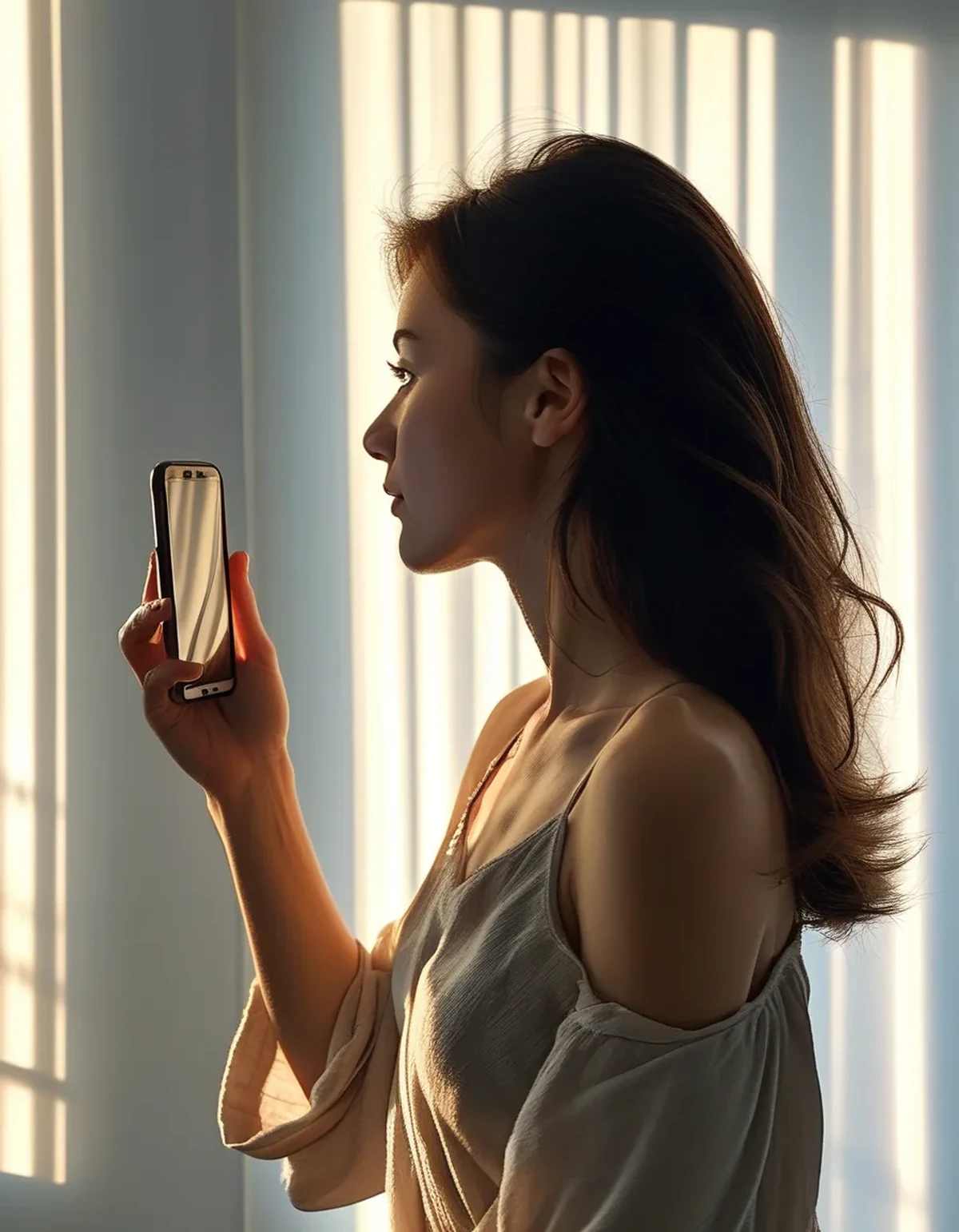
What are the actual differences between a mirror and a camera?
Four, and each one is significant on its own.
Lateral inversion. A mirror flips you left to right. Every face is slightly asymmetric, and you have spent your whole life memorizing the flipped version. An unflipped photo therefore reads as subtly wrong even when nothing is wrong. This alone accounts for a surprising amount of the disagreement — try mirroring a photo of yourself and it usually looks more like the person you know.
Focal length. Phone cameras use wide-ish lenses that enlarge whatever is closest and compress what is behind. At close range this widens the nearest features noticeably. A mirror has no focal length effect at all.
Distance and perspective. A mirror at arm’s length shows you at your own eye level. A photo is usually taken from someone else’s height and angle, often below eye level, which changes proportions substantially.
Time. A mirror is continuous — you unconsciously settle into your most familiar posture and expression. A photo captures 1/1000th of a second, frequently mid-blink, mid-word, or mid-shift of weight.
Why does the photo feel more true?
Because it is a physical object you can examine repeatedly — which has nothing to do with accuracy.
Permanence reads as evidence. A still image can be studied, zoomed, and compared. That feels like proof, but it is proof of one thousandth of a second from one angle with one lens.
Familiarity works against it. Your brain recognizes the mirror version as you. The photo version is genuinely less familiar, and the mind tends to interpret unfamiliar as unflattering.
You examine photos differently. In a mirror you look at yourself as a whole and usually briefly. In a photo you scan feature by feature, looking for problems. The viewing behavior is different, so the conclusion is different.
Other people do not see either version. They see you moving, at conversational distance, at their eye height, with no lens and no freeze frame. Nobody experiences you the way a photo does.
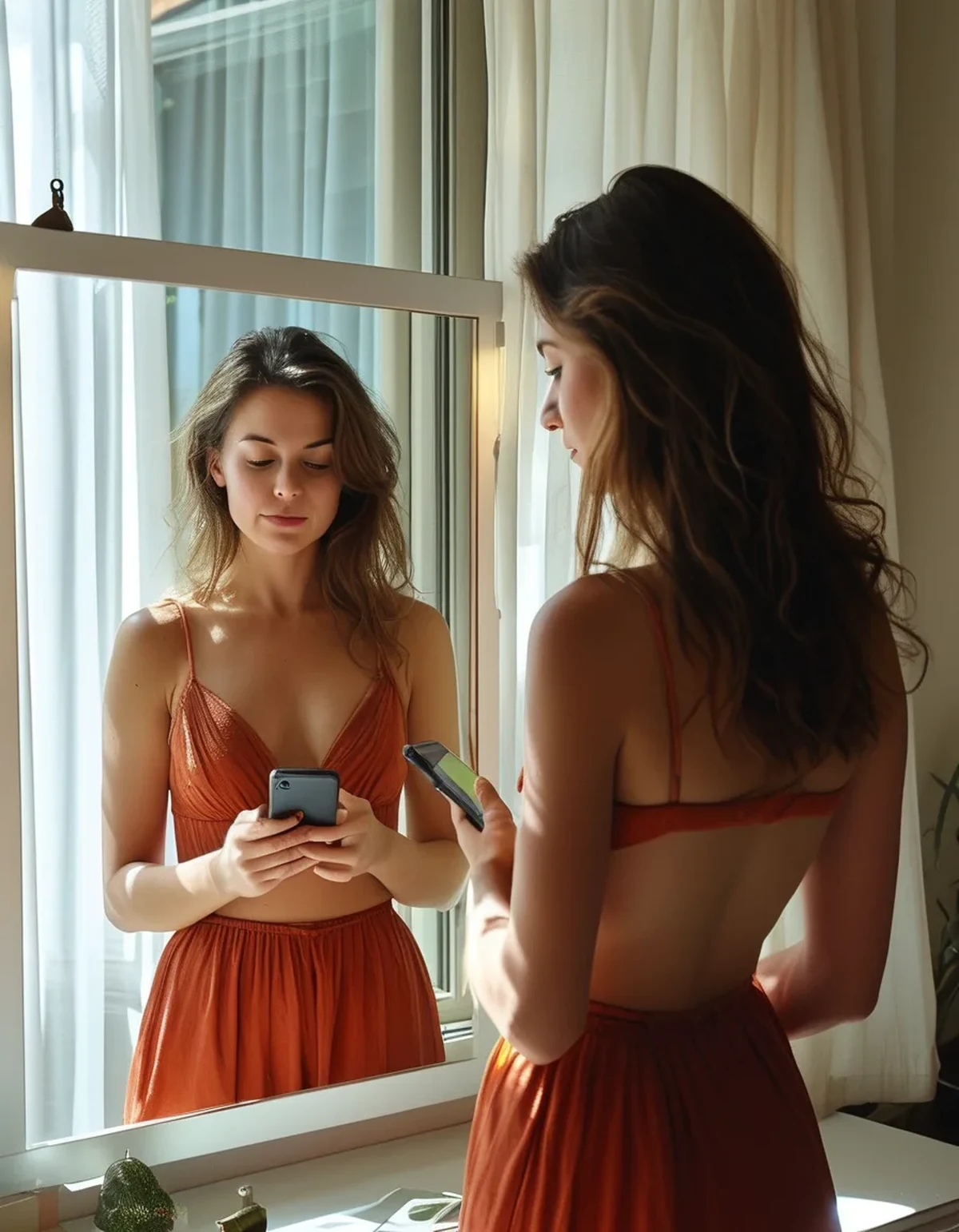
Which one should you use to judge anything?
Neither, alone. If you need a reference, standardize it.
For clothes, use a photo — same conditions each time. Same spot, same light, same distance, camera at chest height. Consistency is what makes a photo useful; you are comparing outfits, not judging your body.
For fit and movement, use the mirror. Whether something rides up, gaps, or restricts you is a moving question and the mirror answers it better.
For change over time, use measurements and how clothes fit. Both photos and mirrors are too sensitive to light, angle, posture, time of day, and bloating to track anything reliably.
Stand back for photos. Have the camera at least six feet away, at chest height, and zoom slightly if you can. That single change removes most wide-lens distortion and makes the photo look far more like the mirror.
What Nobody Tells You About Photos of Yourself
Camera height changes your proportions more than anything else. A photo taken from below lengthens the lower body and shortens the torso; from above it does the opposite. Most unflattering photos are simply taken from a bad height by someone shorter or taller than you.
Phone portrait modes reshape faces. Many phones apply subtle smoothing, and some apply geometric correction. The photo is already an interpretation before you look at it.
Mid-motion always looks strange. Walking, talking, and laughing all pass through positions that look odd frozen. This is why candid photos of everyone look worse than posed ones — it is not specific to you.
Group photos have a position problem. Whoever stands at the edge of a wide-lens frame gets stretched. If you consistently dislike group photos, check whether you consistently stand on the end.
Your mirror is also editorial. Cheap mirrors flex slightly and distort. Mirror position relative to your light source changes shadow and apparent shape considerably. The mirror is not a neutral instrument either.
Both get better with a standard setup. Fixing the light, the distance, and the camera height once means your photos stop delivering unpleasant surprises — not because you changed, but because the measurement finally became consistent.
TL;DR:
- A mirror is flipped, life-sized, binocular, continuous, and deeply familiar. A photo is unflipped, lens-distorted, single-angle, and frozen.
- Lateral inversion alone explains a lot — mirroring a photo usually makes it look more like the person you recognize.
- Camera height and focal length change proportions more than almost anything about your body.
- Photos feel truer only because they are examinable objects, not because they are more accurate.
- To compare outfits, standardize the photo: six feet back, chest height, same spot and light. To judge fit and movement, use the mirror.
- Track change with measurements and clothing fit, not with either image.
Neither the mirror nor the camera is showing you what other people see, because other people see you moving, at conversational distance, with no lens between you. Once you know which distortions each device introduces, the disagreement stops being a verdict and becomes what it actually is — two different instruments.
Keep Reading
This article is for general informational and styling purposes only. Fit, sizing, and product availability may vary.
